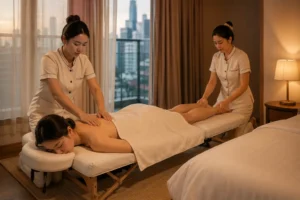
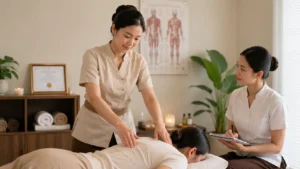
For most people, 90 minutes is the right length for a massage. Sixty minutes covers one area properly or a quick full-body reset, 90 minutes is enough for a full body with time to work on the tight spots, and 120 minutes suits deep tension, two problem areas, or anyone who wants an unhurried session with nothing left out.
The honest answer is that the length you book changes what your therapist can actually do. Time is the raw material of a massage. A shorter session forces choices about what gets skipped, and a longer one buys the thing that makes a massage work: time to find the tight tissue, warm it, and stay with it long enough for it to let go. This guide breaks down exactly what fits into each length, so you can book the one that matches what you need instead of guessing.
- 60 minutes: one focus area done well, or a light full body. The default for a first try or a regular top-up.
- 90 minutes: the sweet spot. Full body, plus real time on your back, shoulders, or legs. Most people should book this.
- 120 minutes: full body with deep, detailed work, or two problem areas. Best for chronic tension and desk-related stiffness.
- 180 minutes: an indulgence session or a combination of styles. Rare, but it exists.
- Traditional Thai massage benefits most from the extra time, because the full sequence of stretches is long by design.

- Most booked90 minutes
- Best for one sore area60 minutes
- Best for chronic tension120 minutes
- Full body needs at least90 minutes
What the length actually buys you
A massage is not a fixed treatment squeezed into a slot. It is a sequence, and the therapist decides on the spot how much time each part of your body gets. That means the number you book is really a budget. Book 60 minutes and your therapist has to spend it carefully. Book 90 and the same therapist can warm the tissue first, work the tight areas properly, and still finish the rest of you without rushing.
Here is the part most people underestimate. Muscle does not release on command. It needs warming, then sustained pressure, and then a little time to settle. In a short session, that whole cycle can only happen in one or two places. Everywhere else gets a pass rather than treatment. That is fine if a pass is what you want. It is not fine if you came in with a knot in your shoulder that has been there since March.
60 minutes: what fits
Sixty minutes is a real massage, not a taster. It is enough for either a genuine full-body pass that touches everything lightly, or focused work on one region, such as the back and shoulders, done properly. It is not enough for both.
Choose 60 minutes if you are trying massage for the first time and want to see how you feel about it, if you already get regular massages and this is a maintenance session, if you have one clear sore area and nothing else on the list, or if your schedule genuinely will not stretch further. It is also the sensible length late at night, when a long session would leave you too alert to sleep.
Be aware of one trade-off. In 60 minutes of traditional Thai massage the therapist has to compress a sequence that traditionally runs much longer, so the stretches come faster and some of the leg and foot work gets shortened. It still works. It just moves at a different pace.
90 minutes: the sweet spot
If you take one thing from this guide, take this. Ninety minutes is the length most people should book, and the extra half hour changes the session more than the numbers suggest.
Thirty extra minutes is not thirty extra minutes of the same thing. It is the margin that lets your therapist do the full sequence and then go back to whatever needed more. The neck that was still tight on the first pass gets a second one. The stretches get held for their proper length instead of being cut short. The end of the session is calm rather than a countdown. In practice, 90 minutes is where clients stop saying "I wish they had spent longer on my shoulders".
Book 90 minutes if you want a full-body massage and mean it, if you sit at a desk all day and carry it in your neck and upper back, if you want a Thai massage with the stretches done at their natural pace, or if you are unsure and want the safe choice. It is the default recommendation for a reason.
Booking 60 minutes and then asking the therapist to focus on your back is a reasonable plan. Booking 60 minutes and expecting a thorough full-body massage plus deep work on a problem area is not. The therapist cannot create time. Be honest about your priority at the start of the session and they will spend the budget where it matters.
120 minutes: deep and unhurried
Two hours is for when the tension has been there a while. It gives room for the full body plus deep, detailed work on more than one area, and it is the length that suits chronic stiffness, the kind that comes from years at a desk or long-haul flights and hotel beds.
It also changes the quality of the session. There is time to work slowly, which matters, because deep pressure applied fast is uncomfortable and less effective. There is time to combine approaches, for example Thai stretching for the legs and hips, then focused pressure on the upper back. And there is time for you to switch off completely, which for a lot of people is the point. If you have never let a massage run past the hour mark, the second hour of a good one is a different experience.
Choose 120 minutes if you have two problem areas, if you carry serious tension and want it addressed rather than acknowledged, if you are combining a deep-tissue focus with a full body, or if the session is a treat and you want to stop watching the clock. Consider whether deep tissue massage is right for you before booking the longest version of it, since firm pressure over two hours is a lot for a first-timer.
180 minutes: the long session
Three hours is unusual, and it is not for everyone. Where it makes sense is a combination session, for example a Thai massage followed by an oil massage, or a full body with genuinely deep work everywhere rather than in one or two places. It also suits people who are using the session as a proper reset after a punishing travel schedule.
The caution is simple. Very long sessions of deep pressure can leave you tender the next day, so if you go long, tell your therapist to keep the pressure moderate for most of it and save the deep work for the areas that need it.
60 vs 90 vs 120 side by side
| Length | What fits | Best for | Skip it if |
|---|---|---|---|
| 60 min | A light full body, or one area worked properly. Not both. | First-timers, maintenance sessions, one sore spot, a late-night wind-down. | You want a full body and real work on a problem area. |
| 90 min | Full body at a natural pace, plus real time on the tight areas. | Most people. Desk workers, full-body Thai massage, anyone unsure. | You genuinely only have an hour. |
| 120 min | Full body plus deep, detailed work on two or more areas. | Chronic tension, stubborn knots, combining styles, a full switch-off. | You are new to firm pressure and unsure how your body will react. |
| 180 min | Two styles combined, or deep work across the whole body. | A serious reset, a special occasion, recovering from heavy travel. | You have never had a massage longer than an hour. |
Does the massage type change the answer?
It does, and this is the part most guides leave out.
Traditional Thai massage
Thai massage gains the most from extra time. The traditional sequence moves through the legs, arms, back, and then the assisted stretches, and it was never designed to be finished in an hour. At 60 minutes it is compressed. At 90 it breathes. If you are booking traditional Thai massage in Bangkok for the first time, 90 minutes gives you the honest version of it.
Oil and aromatherapy massage
Flowing oil work adapts more gracefully to 60 minutes, because the strokes are continuous and there is no long sequence to fit in. Sixty minutes of oil massage feels complete in a way that 60 minutes of Thai massage sometimes does not. Ninety still gives a better session, but the gap is smaller. If you are weighing the two styles, our guide to Thai massage versus oil massage covers the difference.
Deep tissue
Deep tissue is the one where more is not automatically better. The work is slow and intense, and there is a limit to how much of it your body wants in one sitting. Ninety minutes is usually ideal: enough to warm the area, work it, and finish gently. Two hours works well when the deep focus is on one region and the rest of the session stays moderate.
What the research says about dose
There is actual evidence on this, and it points in one direction. A dosing trial published in the Annals of Family Medicine in 2014 randomised 228 people with chronic neck pain into groups receiving different amounts of massage over five weeks. The 30-minute treatments were not significantly better than the wait-list control, whatever the frequency. The 60-minute treatments given two or three times a week produced significant improvements in both neck dysfunction and pain intensity. The authors concluded that multiple 60-minute massages per week were more effective than fewer or shorter sessions.
Shorter sessions did not beat doing nothing. The longer ones did.
Sherman et al., Annals of Family Medicine, 2014That study was about therapeutic massage for a specific pain condition, so it does not translate directly into "always book 120 minutes for relaxation". What it does tell you is that when you are using massage to change something in your body rather than simply to feel good for an hour, length matters, and it is the first thing to increase.
The value maths people miss
Session lengths are not priced in a straight line, and this works in your favour. Take traditional Thai massage as the example. The first 60 minutes are ฿900. The next 30 minutes are ฿200 more, taking a 90-minute session to ฿1,100. You are buying the most valuable half of the session, the part where your therapist actually gets to work on what is tight, at the lowest rate of the whole booking.
Put another way, the extra 30 minutes costs roughly a fifth of what the first hour did, and it is usually the part you remember. If you are choosing between one 60-minute massage this week and one 90-minute massage this week, take the 90. Full rates for every style and length are on our massage pricing in Bangkok page.
If the therapist is coming to you
An outcall massage adds one factor that a spa visit does not have. Your therapist travels to your hotel or condo and sets up on arrival, and packs down at the end. None of that comes out of your session time, but it does mean a very short booking makes the visit lopsided: a lot of logistics around a small treatment. For a therapist coming to you, 90 minutes is the length that makes the whole thing feel worth doing for both sides.
The other advantage is what happens afterwards. In a spa you get dressed and step into Bangkok traffic. At home or in your hotel room you can lie there. That is worth something, and it is an argument for booking the longer session, because you get to keep the state it leaves you in. Our guide on what to expect before your session covers the practical side of the visit.
How to choose in 30 seconds
Book 90 if
- You want a full-body massage
- You work at a desk and feel it in your neck
- You are booking traditional Thai massage
- You are not sure which to pick
- A therapist is travelling to you
Book 60 or 120 if
- 60: it is your first massage and you want to test it
- 60: one sore area, nothing else
- 60: it is late and you want to sleep straight after
- 120: the tension is chronic, not recent
- 120: you have two areas that both need real work
One last piece of advice, and it is the one that changes sessions most. Whatever length you book, tell your therapist at the start what you want out of it. "Please spend most of the time on my upper back" is more useful than any duration you can choose, because it tells them how to spend the budget you just gave them.
Book the length that suits you
Every style is available in 60, 90, 120, and 180 minutes, and a therapist can be at your hotel or condo without you going anywhere. If you are still unsure, book 90 and tell your therapist where it hurts. Questions about how a session works are answered in our common questions.
Book your massageFrequently asked questions
How long should a massage be?
Ninety minutes suits most people. Sixty minutes covers a light full body or one area worked properly, 90 minutes allows a full body plus real time on the tight areas, and 120 minutes is best for chronic tension or two problem areas. If you are unsure, book 90 minutes and tell your therapist what needs the most attention.
Is a 60-minute massage long enough?
Yes, for a maintenance session, a first massage, or one clear sore area. It is not long enough for a thorough full-body massage plus deep work on a problem area, because the therapist has to choose between them. It is also the most compressed option for traditional Thai massage, since the full traditional sequence is longer than an hour by design.
Is a 90-minute massage worth it over 60?
For most people, yes. The extra 30 minutes is the part where the therapist returns to the areas that needed more work, so it changes the session more than the extra time suggests. It is also the best-value half hour of the booking, since prices do not rise in a straight line with length.
When should I book a 2-hour massage?
Book 120 minutes when the tension is chronic rather than recent, when two areas both need real work, or when you want deep work done slowly enough to be comfortable. It also suits combining styles, such as Thai stretching for the legs and focused pressure for the upper back. If you are new to firm pressure, start at 90 minutes.
Does a longer massage actually work better?
For treating a specific problem, the evidence says length matters. A 2014 dosing trial in the Annals of Family Medicine found that 30-minute massages were not significantly better than no treatment for chronic neck pain, while 60-minute massages given two or three times a week produced significant improvements in pain and function. For general relaxation, book what fits your day, but do not expect an hour to fix something that took years to build.
Source: Sherman KJ, Cook AJ, Wellman RD, et al. Five-week outcomes from a dosing trial of therapeutic massage for chronic neck pain. Annals of Family Medicine. 2014;12(2):112-120. This article is general information and is not medical advice.