Traditional Thai massage grew out of two lineages. Court-style, also called royal-style, uses only the hands and thumbs with gentle, precise pressure while the therapist stays at a respectful distance. Common-style, also called folk or rural-style, uses the whole body, including elbows, knees, and feet, along with the big assisted stretches most people picture.
Both are the same tradition, taught side by side in Thailand for generations. What changes is the technique, the etiquette behind it, and how the session feels. This guide explains where each style came from, how they differ in practice, and which one you are most likely to receive today.
- Court-style (Thai: ราชสำนัก, royal-style) uses hands and thumbs only, with the therapist working at a respectful distance. It is gentle, precise, and therapeutic.
- Common-style (Thai: เชลยศักดิ์, folk or rural-style) uses the whole body plus dynamic stretches. It is more vigorous and covers more ground.
- Both work along the same sen energy lines and share the same roots in traditional Thai medicine.
- Most sessions today blend the two, leaning toward the common-style you feel in the stretches.

- Court-styleราชสำนัก (royal / court)
- Common-styleเชลยศักดิ์ (folk / rural)
- Court touchHands and thumbs only
- Common touchWhole body plus big stretches
The two traditions of Thai massage
Traditional Thai massage was never one fixed method. As it developed, it split into two branches that suited two very different worlds. One was refined inside the royal palaces, where etiquette shaped every movement. The other stayed with ordinary people in villages and temples, where the goal was to ease the aches of hard physical work. Thailand kept both alive, and today they are taught together as the two recognised styles of the practice.
They are not rivals, and neither is the original that the other copied. They are two expressions of the same body of knowledge, worked along the same energy channels called the sen lines. If you want the wider background on the practice they both belong to, our guide on what Nuad Thai is covers its history and heritage listing.
Court-style (royal) Thai massage
Court-style is known in Thai as ราชสำนัก, often written Rachasamnak and translated as royal-style or court-style. As the name suggests, it was developed to treat royalty and the nobility. That setting shaped the technique in a very direct way. A practitioner working on a member of the royal court had to observe strict etiquette, which meant keeping a respectful distance from the body and never looming over the person being treated.
Out of that etiquette came the defining feature of the style. The therapist uses only the hands and thumbs, kneeling beside the client at roughly an arm's length and applying careful, targeted pressure to points along the sen lines. There are no elbows, no knees, and no feet, and the big dramatic stretches are kept to a minimum. The result is slower, gentler, and more precise. Because it grew up close to Thai traditional medicine, court-style is often described as the more clinical or therapeutic of the two, favoured for working carefully on specific problem areas.
Court-style being gentler does not mean it is weak. The precise thumb pressure on a single tight point can feel surprisingly deep. It simply reaches that depth through accuracy rather than through the therapist's body weight.
Common-style (folk) Thai massage
Common-style is known in Thai as เชลยศักดิ์, often written Chaloeisak and translated as folk-style, rural-style, or common-style. This is the massage of ordinary Thai life, practised in villages, homes, and temples to relieve the muscle fatigue of farming, walking, and manual labour. Without the etiquette of the palace, the practitioner was free to use whatever worked best.
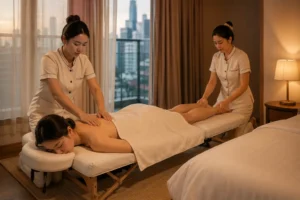
That freedom is exactly what you feel in a common-style session. The therapist uses the whole body as a set of tools, pressing with thumbs, palms, forearms, elbows, knees, and feet to reach different depths, and walking you through the wide, sweeping assisted stretches that many people compare to passive yoga. It covers the whole body in a flowing sequence and feels more energetic and dynamic. This is the style most visitors to Thailand picture when they think of Thai massage, because it is the one most often given in shops and to travellers.

Court-style vs common-style: the differences at a glance
The two styles share a foundation but part ways in almost every practical detail. Here is how they line up.
Court-style (royal)
- Thai name: ราชสำนัก (Rachasamnak)
- Developed for royalty and the court
- Hands and thumbs only
- Therapist works at a respectful distance
- Precise point pressure, few big stretches
- Gentle, slow, therapeutic feel
Common-style (folk)
- Thai name: เชลยศักดิ์ (Chaloeisak)
- Grew up among ordinary villagers
- Hands, elbows, knees, and feet
- Therapist works close and hands-on
- Broad pressure plus large assisted stretches
- Vigorous, dynamic, full-body feel
One point is worth stressing, since transliterations of the Thai names vary from one school to another. You may see court-style written as Rajasamnak or royal Thai massage, and common-style as Chaloeysak, folk, or general-style. They refer to the same two traditions described here.
Which style you actually get today
In practice, the strict line between the two has softened. Most Thai therapists are trained in the common-style stretches and pressure that suit a general clientele, and many weave in the precise thumb work of the court-style when a client needs careful attention on one area. So a typical session today is usually a blend that leans common-style, with the court-style precision brought in as needed.
Pure court-style is rarer and tends to be found through therapists who trained specifically in the traditional medical lineage, or at teaching centres such as Wat Pho in Bangkok, which has preserved and taught traditional Thai massage for generations. If a purely gentle, hands-only treatment matters to you, it is worth asking about directly rather than assuming, since the default in most places is the more vigorous common-style.
A different classification worth knowing
It is easy to mix up the court-versus-common split with another way Thai massage is divided, so it helps to separate them clearly. Court and common describe the technique lineage, meaning how the therapist uses their body. There is a second, separate classification based on the goal of the session: therapy, aimed at a specific ache or condition, and health promotion, aimed at general wellbeing. That second split is the one recognised in the heritage listing, and we cover it in the section on the two recognised types in our Nuad Thai guide. A single massage can sit anywhere on both maps at once, for example a gentle court-style treatment given purely for relaxation.
Court vs common answers "how does the therapist work?" Therapy vs health promotion answers "what is the session for?" They are two separate questions, not two names for the same thing.
Which style is right for you
Neither style is better, and the right one depends on what you are after on the day. Reach for the gentler court-style approach if you prefer light, careful pressure, if you are new to Thai massage and unsure about deep work, or if you want focused attention on one tender area without a lot of movement. Reach for the common-style if you enjoy a firm, energetic session, if stiffness and tight muscles are your main complaint, and if the deep stretches are the part you look forward to.
Both stay true to what makes Thai massage distinct. You remain fully clothed in loose clothing, no oil is used, and the work follows the sen lines rather than gliding over the skin, the way our guide on the sen energy lines explains. Thai massage is a wellness practice rather than a medical treatment, so if you have an injury, a health condition, or any doubt, check with your doctor first and tell your therapist before the session begins. If you would rather compare the clothed Thai style against a softer oil session, our guide on Thai massage versus oil massage lays out the difference.
Trying traditional Thai massage in Bangkok
You can experience either style without leaving your room. A qualified therapist can bring a mat to your hotel or condo, set up in a few minutes, and give you a full clothed session in the traditional style. Tell them whether you prefer gentle, precise work or a firmer session with plenty of stretching when you book traditional Thai massage in Bangkok. New to it and have questions first? Our Thai massage FAQ answers the common ones.
Book a massageFrequently asked questions
What is the difference between court-style and common-style Thai massage?
Court-style (royal-style) uses only the hands and thumbs, with the therapist working at a respectful distance and applying precise pressure. Common-style (folk-style) uses the whole body, including elbows, knees, and feet, plus large assisted stretches, and feels more vigorous.
What is royal Thai massage?
Royal Thai massage is the English name for court-style, known in Thai as ราชสำนัก or Rachasamnak. It was developed to treat royalty, so etiquette required the therapist to keep a respectful distance and use only the hands and thumbs. It is gentler and more precise than common-style.
Which style of Thai massage will I usually get?
Most sessions today are a blend that leans toward common-style, since that is what suits a general clientele and includes the stretches people expect. Precise court-style thumb work is often mixed in when one area needs careful attention. Pure court-style is less common and worth asking for directly.
Is court-style Thai massage gentler than common-style?
Generally yes. Court-style relies on careful thumb and hand pressure with few big stretches, so it feels slower and gentler. That said, targeted pressure on a tight point can still feel deep. Common-style is more energetic because it uses the whole body and wide assisted stretches.
Are court-style and common-style the same as therapy and health-promotion Thai massage?
No. Court and common describe the technique, meaning how the therapist works. Therapy versus health promotion describes the goal of the session, meaning whether it targets a specific problem or general wellbeing. They are two separate ways of classifying the same practice.