Nuad Thai is the traditional Thai massage that has been practised in Thailand for centuries. In 2019, UNESCO added it to the Representative List of the Intangible Cultural Heritage of Humanity, the same list that protects other recognised cultural traditions around the world.
A Nuad Thai session is done with the client fully clothed on a firm mat, using pressure, rhythmic compression, and assisted stretching rather than oil. This guide explains what the practice is, where it came from, and what actually happens in a session.
- Nuad Thai means traditional Thai massage (also called Nuad Boran, "ancient massage").
- UNESCO recognised it as Intangible Cultural Heritage in 2019.
- You stay fully clothed on a floor mat. No oil. The therapist uses pressure and assisted stretches.
- A session usually runs 60 to 120 minutes.

- OriginThailand
- UNESCO heritageInscribed 2019
- StyleClothed, on a mat, no oil
- Typical length60 to 120 minutes
What Nuad Thai means
The name comes from Thai. "Nuad" means to press or knead, and "Thai" points to where it comes from. You will also see it written as Nuad Boran, which means ancient massage, or simply called traditional Thai massage. They all refer to the same practice. The therapist works along the body with palms, thumbs, elbows, knees, and feet, moving you through positions instead of asking you to lie still the whole time.
The UNESCO heritage listing
In December 2019, UNESCO inscribed Nuad Thai on the Representative List of the Intangible Cultural Heritage of Humanity, under reference number 01384. The official description is worth reading in full:
"Bodily manipulation in which the practitioner helps rebalance the patient's body, energy and structure to treat illnesses believed to be caused by the obstruction of energy flow along 'sen', lines understood to crisscross the human body."
UNESCO, Intangible Cultural Heritage of Humanity
That recognition matters for one simple reason. It marks Nuad Thai as a documented cultural tradition with a long lineage, not a modern spa invention. You can read the official entry on the UNESCO Intangible Cultural Heritage site.
Where Nuad Thai comes from
UNESCO traces the practice back to self-care in rural Thai society. In its words, "every village had massage healers whom villagers would turn to when they had muscle aches from working in the field." Over the centuries it became linked to Thai medicine and to Buddhist temples, which kept the knowledge alive and passed it down. Wat Pho in Bangkok is the best known teaching centre, with stone inscriptions and diagrams of the body's energy lines on its grounds. In Thai tradition, a physician named Jivaka Komarabhacca, associated with the time of the Buddha, is honoured as the founding teacher of the practice.

How a Nuad Thai session works
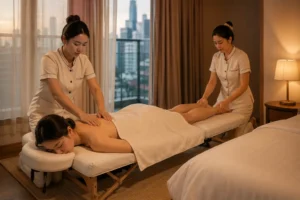
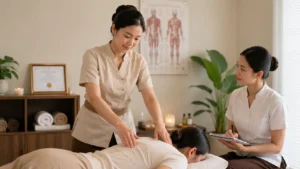
A few things set Nuad Thai apart from the oil massage most visitors picture. There is no oil, and you stay fully clothed in loose, comfortable clothing. The work happens on a firm mat on the floor rather than a raised table. The therapist applies steady pressure along the body and guides you through assisted stretches that many people compare to passive yoga, since the therapist does the moving for you.
The therapist uses hands, thumbs, elbows, knees, and feet to reach different depths and angles. A warm herbal compress is sometimes pressed against tight areas to ease the muscle before stretching. A full session usually runs 60 to 120 minutes. The longer formats give the therapist time to work the legs, back, shoulders, and neck in sequence instead of rushing.
Wear loose, comfortable clothing you can stretch in. You stay fully dressed for the whole session, so there is no need to undress or use a towel.

Sen lines and the four elements
Traditional Thai theory describes a network of energy channels called sen lines that run through the body. The therapist presses and stretches along these lines with the aim of clearing blockages and letting energy move freely. Thai tradition also frames the body in terms of four elements: earth, water, wind, and fire, and sees good health as keeping them in balance. You do not need to believe the underlying theory to feel the physical result. The pressure releases muscle tension and the stretches open up stiff joints, whatever language you use to describe it.

Two recognised types: therapy and health promotion
UNESCO notes that Nuad Thai is classified into two main types. The first is therapy, used to address specific aches, stiffness, and tension. The second is health promotion, used for general wellbeing and to keep the body relaxed and mobile. The same hands-on techniques sit behind both. The difference is the goal, whether you are treating a sore lower back or simply unwinding after a long day.

How Nuad Thai differs from oil massage
The short version: Nuad Thai is clothed, dry, and built around stretching and pressure, while an oil massage is done on bare skin with long gliding strokes and a relaxing focus. Neither is better. They suit different moods and different bodies.
Nuad Thai
- Fully clothed
- On a firm floor mat
- No oil
- Pressure and assisted stretching
- Best for stiffness and tight muscles
Oil massage
- On bare skin
- On a padded table
- Warm oil
- Long gliding strokes
- Best for deep relaxation
We break the comparison down further in our guide on Thai massage versus oil massage.
What Nuad Thai is good for
People reach for Nuad Thai mainly for tight muscles, stiff joints, and the kind of all-over tension that builds up from desk work, travel, and long days on your feet. The assisted stretching can help with flexibility and range of motion, and the slow pressure tends to leave people feeling looser and calmer afterwards. It is a wellness practice rather than a medical treatment, so if you have an injury or a health condition, check with your doctor first and tell your therapist before the session. For a longer read on why hands-on therapy works, see our piece on touch as medicine.
Trying authentic Nuad Thai in Bangkok
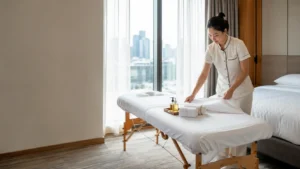
You do not have to go out to experience it. A qualified therapist can bring the mat and a herbal compress to your hotel room or condo, set up in a few minutes, and give you a full traditional session where you are staying. If you want the classic clothed, mat-based style, ask for traditional Thai massage in Bangkok when you book. Still have questions before your first session? Our Thai massage FAQ covers the common ones.
book a massageFrequently asked questions
What does Nuad Thai mean?
Nuad Thai means traditional Thai massage. "Nuad" is the Thai word for pressing or kneading. It is also called Nuad Boran, which means ancient massage.
Is Nuad Thai the same as Thai massage?
Yes. Nuad Thai is the formal name for the traditional Thai massage practised in Thailand. The clothed, mat-based, stretching style is what UNESCO recognised in 2019.
When did Nuad Thai become a UNESCO heritage?
UNESCO inscribed Nuad Thai on the Representative List of the Intangible Cultural Heritage of Humanity in December 2019, under reference 01384.
Is oil used in a Nuad Thai massage?
No. Nuad Thai is a dry massage done with the client fully clothed. The therapist uses pressure and assisted stretching instead of oil. Oil massage is a separate style done on bare skin.
Is Nuad Thai painful?
It should feel firm but not painful. A good therapist works to your comfort level and adjusts the pressure. Tell your therapist if a stretch or pressure point feels too strong and they will ease off.