In Thailand, a Thai massage therapist is not simply someone who is good with their hands. Thai massage therapist training is a formal, regulated process: it is taught in accredited schools and certified through the Ministry of Public Health. That regulation is the quiet difference between a trained professional arriving at your door and a stranger with a bottle of oil.
If you are booking a massage in Bangkok, especially an outcall one where the therapist comes to your room, knowing how therapists are actually trained tells you what "certified" is supposed to mean and how to check that it is real. Here is how the training and licensing system works, and the simple ways to confirm the person treating you has been through it.
- It is regulated. Thai traditional massage is overseen in Thailand by the Ministry of Public Health, and practitioners are certified through it or through accredited institutions.
- It is taught in real schools. Recognised training programmes commonly run from around 150 to 500 hours, depending on the level.
- Certification is a document, not a vibe. A trained therapist holds a certificate from an accredited school, and bodies such as the Union of Thai Traditional Medicine Society set the standard.
- Heritage adds a benchmark. Thai massage, or Nuad Thai, is recognised as cultural heritage, and its most famous school sits inside the Wat Pho temple in Bangkok.
- You can check. A professional service will confirm its therapists are certified, and you are entitled to ask.
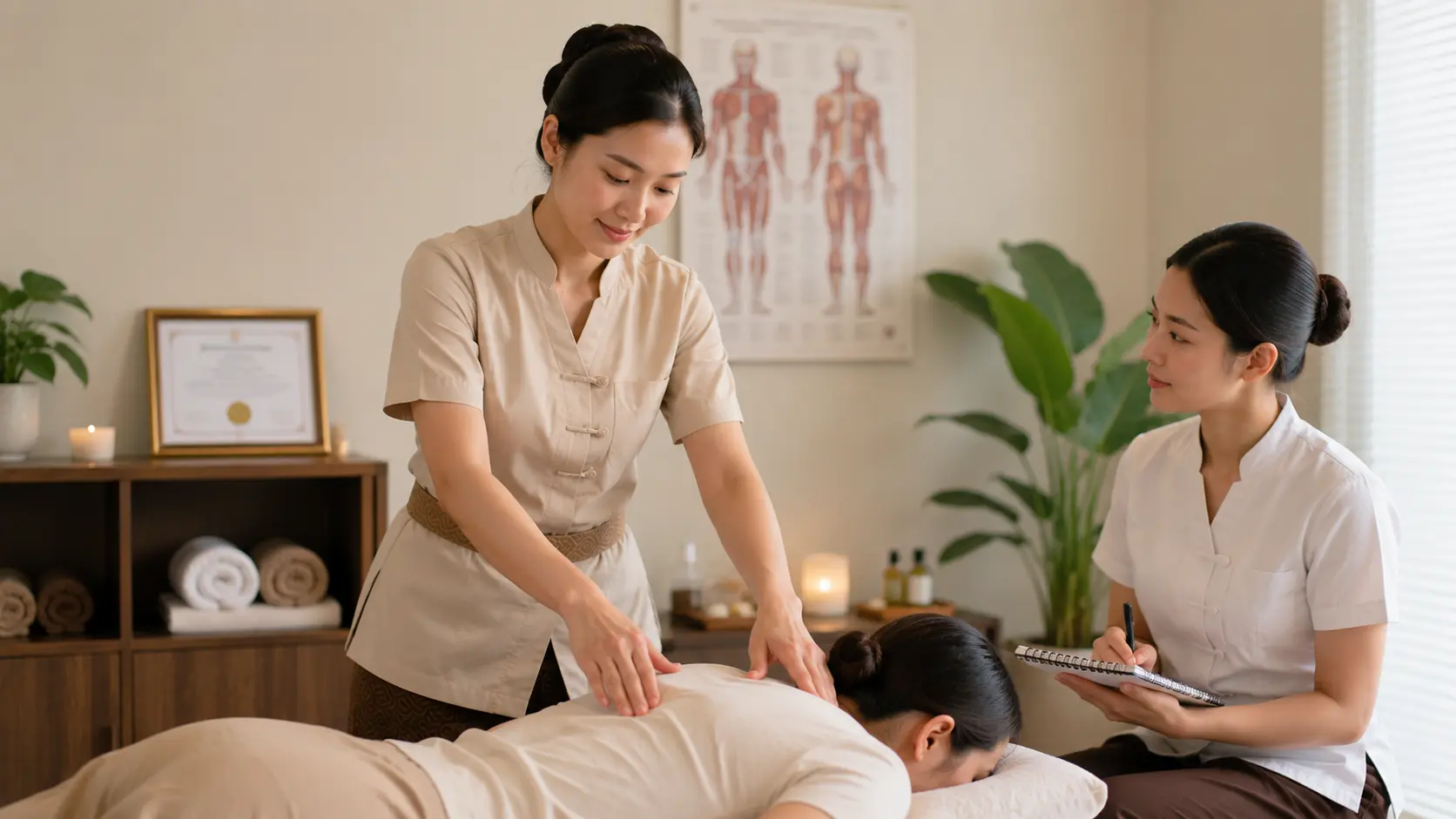
- RegulatorMinistry of Public Health
- Typical training~150 to 500 hours
- Renowned schoolWat Pho, Bangkok
- Proof of trainingA certificate you can ask for
Are Thai massage therapists licensed in Thailand?
Yes. Thai traditional massage is treated as a branch of Thai traditional medicine, and it is regulated by the country's Ministry of Public Health. Therapists who practise it professionally are expected to be certified either directly through the Ministry or through a school that the Ministry accredits. This is not a loose custom. It is a formal system with institutions, curricula, and paperwork behind it.
That regulation is exactly why the word "certified" should carry weight, and why it is worth confirming rather than assuming. A certificate means the person completed a recognised course and met a defined standard. The absence of one means nothing has been verified at all.
How Thai massage therapist training works
Training happens in dedicated schools, not on the job. A student learns the anatomy, the pressure points, the sen energy lines that run through the body, and the sequences that make a Thai massage a Thai massage rather than a generic rub. It is physical, technical, and slow to master.
The length of study varies with the depth of the qualification. Recognised programmes in Thailand commonly range from around 150 hours for a solid foundation up to 500 hours or more for advanced and therapeutic work. A widely cited baseline is a 150 hour programme from a school accredited by the Thai Ministry of Education and the Ministry of Public Health.
Good hands are not the qualification. The qualification is the hundreds of hours, the accredited school, and the certificate that says a defined standard was met.
The levels of training
Not every certificate represents the same amount of study. Broadly, training stacks up in levels, and knowing them helps you read what a therapist's qualification actually covers.
| Level | Roughly | What it covers |
|---|---|---|
| Foundation | ~150 hours | Core traditional Thai massage: sequences, pressure, sen lines, safe practice. The recognised baseline for professional work. |
| Professional | ~300 hours | Broader technique across styles, more anatomy, treatment of common conditions, and client care. |
| Advanced / therapeutic | 500 hours or more | Therapeutic and medical Thai massage, deeper diagnosis, and specialised work. The upper end of formal training. |
Most therapists you will meet through a reputable outcall service sit comfortably in the foundation to professional range, with real hours behind them and often years of practice on top. A skilled therapist also trains across oil, aromatherapy, and deep tissue work, so a single booking can flex to what your body needs. If you want the background on the tradition itself, our explainer on what Nuad Thai is covers its roots and its recognised heritage.
What "certified" actually means
Certification is the proof that the hours happened. When a therapist is certified, it means an accredited school has confirmed they completed its programme and reached its standard. In Thailand, bodies such as the Union of Thai Traditional Medicine Society work closely with the Ministry of Public Health to set and protect those standards, and their certificate is often the document a therapist uses to demonstrate professional training.
The practical point for you is simple. "Certified" should mean there is a piece of paper from a named institution, not a claim floating in an advert. That distinction is the whole game, and it is the same instinct that protects you from the fake operators we describe in our guide to massage scams in Bangkok.
Why the heritage matters more than it sounds
Thai massage is not a modern spa invention. It is a centuries old healing tradition, and its most famous training ground is the school inside the Wat Pho temple in Bangkok, long regarded as the home of traditional Thai massage. That lineage is why the practice has formal curricula and recognised standards in the first place. It also sets a benchmark that a serious therapist is trained toward, which is a large part of what separates a genuine traditional Thai massage from an imitation of one.
How a good outcall service vets its therapists
Training is only half of it. When a therapist travels to your hotel or home, the service that sends them carries a responsibility that a walk in shop does not, because you are receiving the treatment in a private space. A professional outcall service does more than glance at a certificate.
- Confirms each therapist holds a genuine certificate in traditional Thai massage before they ever take a booking.
- Assesses skill in person, not just on paper, so technique is checked rather than assumed.
- Trains across modalities, so the same therapist can deliver Thai, oil, aromatherapy, or deep tissue work competently.
- Stands behind the visit, so there is an accountable business between you and the person at your door.
This is the reassurance you are really paying for with a reputable service. Every therapist listed on our page of massage therapists in Bangkok is a trained professional, which is the baseline, not the bonus.
- Ask the service directly. "Are your therapists certified in Thai massage?" A professional operator answers plainly and without irritation.
- Look for a named business. A real service has a website, a booking system, and a contact you can reach afterwards, not just a phone number on a flyer.
- Notice the professionalism. A trained therapist arrives on time, in uniform, with their own clean equipment, and keeps the session strictly professional.
- Trust the discomfort. If anything about the booking feels evasive about qualifications, that is your answer.
Book a certified therapist to your door
Every Divine Thai Spa therapist is certified in traditional Thai massage and trained across oil, aromatherapy, and deep tissue work, so the person who arrives is a genuine professional. Tell us your location and the treatment you want, and book in minutes on WhatsApp or LINE.
Book your massageFrequently asked questions
Are Thai massage therapists licensed in Thailand?
Yes. Thai traditional massage is regulated by Thailand's Ministry of Public Health, and professional therapists are certified either through the Ministry or through an accredited school. Certification confirms a therapist completed a recognised programme and met a defined standard, which is why it is worth confirming rather than assuming.
How many hours of training does a Thai massage therapist need?
Recognised programmes in Thailand commonly range from around 150 hours for a professional foundation up to 500 hours or more for advanced and therapeutic work. A widely cited baseline is a 150 hour course from a school accredited by the Thai Ministry of Education and the Ministry of Public Health.
What does it mean when a therapist is "certified"?
It means an accredited school has confirmed the therapist completed its programme and reached its standard, and issued a certificate to that effect. In Thailand, bodies such as the Union of Thai Traditional Medicine Society work with the Ministry of Public Health to set those standards. A genuine certification is a document from a named institution, not simply a claim in an advert.
Where do Thai massage therapists train?
In dedicated schools rather than on the job. Thailand's most renowned traditional Thai massage school sits inside the Wat Pho temple in Bangkok, long regarded as the home of the practice, and accredited schools across the country teach recognised curricula in anatomy, pressure technique, and the sen energy lines.
How do I know my outcall therapist is qualified?
Ask the service whether its therapists are certified in Thai massage, and expect a straight answer. Book through a named business with a website and a reachable contact, not a flyer. A trained professional arrives on time, in uniform, with clean equipment, and keeps the session strictly professional. If a booking is evasive about qualifications, treat that as a warning.
Sources:
Thai traditional massage is regulated in Thailand as part of Thai traditional medicine under the Ministry of Public Health, with professional practitioners certified through the Ministry or accredited institutions. Recognised training programmes commonly range from around 150 to 500 hours, with a 150 hour programme from a school accredited by the Thai Ministry of Education and Ministry of Public Health cited as a professional baseline. The Union of Thai Traditional Medicine Society is among the bodies that set and protect Thai traditional medicine standards in alignment with the Ministry of Public Health. Nuad Thai, traditional Thai massage, is recognised as intangible cultural heritage, and its most renowned school is located at Wat Pho temple in Bangkok.
This article describes general training and certification standards for Thai massage and is not a statement about the qualifications of any specific individual outside Divine Thai Spa. Always confirm certification directly with your chosen service.